 Eng
Eng
 Հայ
Հայ
 Рус
Рус

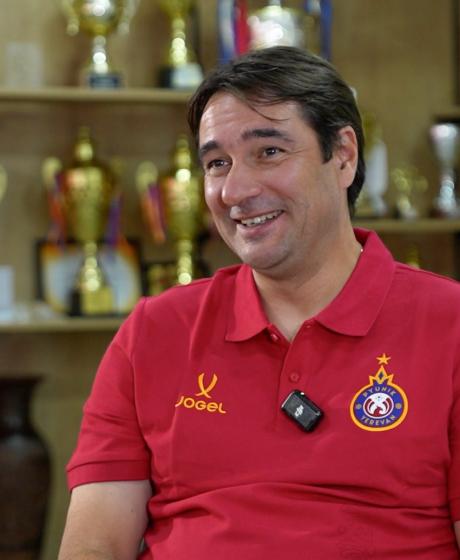
Our club’s General Director Suren Baghdasaryan spoke about a number of important topics in an in-depth interview with the club’s Media Department.
Recently, various discussions have been circulating around Pyunik. How would you comment on the current situation, and what message would you like to convey to the club’s supporters?
The processes taking place at Pyunik have naturally attracted considerable attention. We understand that any changes, especially those concerning the coaching staff or the club’s internal processes, raise many questions, and that is completely natural. Pyunik supporters have the right to know in which direction their club is moving.
First of all, I want to assure everyone that no process at the club is being carried out impulsively or on the basis of one isolated incident. Pyunik continues its work, and all our decisions are based on the club’s long-term interests and development vision.
If we honestly assess the recent period, we must acknowledge that at a certain stage we had deviated somewhat from the policy and principles that should form the foundation of Pyunik’s development. Today, we have a very clear understanding of this and want to return to our main path.
At the same time, every period, including difficult or undesirable situations, should also be an opportunity for us to learn. We are ready to analyze our work, understand where we could have acted more correctly or effectively, and use that experience for further development.
It is very important to distinguish between what we need to preserve and what we need to abandon. We want to eliminate the negative phenomena and bad traditions that may hinder the club’s development and focus on Pyunik’s best traditions—hard work, discipline, the desire to win, the development of our own talent, and responsibility toward the club.
At the same time, when we speak about Pyunik, we cannot speak only about the present. This is a club with a great history, numerous achievements, a unique place in Armenian football, and established traditions. That history is not only a source of pride for us but also a great responsibility. We must preserve the values that have made Pyunik the club it is today and build a stronger future on that foundation.
I want to tell our supporters that the work at Pyunik is continuing. We are not afraid of changes if they are necessary for the club’s progress. At the same time, we understand that any change may require a certain amount of time before its results become visible.
Our task is not only to think about today’s or tomorrow’s match. We want to build a Pyunik that will have a stable foundation for development, a competitive team, and quality footballers emerging from its own system for years to come.
Most importantly, I want our supporters to be confident that the club’s management sees the existing problems and is working to resolve them. We understand the responsibility we carry toward Pyunik’s history, its name, and our supporters.
What can you say about the end of the cooperation with Artak Oseyan? How does the club assess that period, and what led to the decision to make this change?
The cooperation with Artak Oseyan was terminated by mutual agreement. This is an important circumstance that I would like to emphasize.
Artak Oseyan worked with Pyunik as head coach, and during that period there were both positive moments and situations that required discussions and certain assessments.
If we also assess the previous season overall, we would describe it as satisfactory. There were good periods and positive results, but at the same time there were setbacks, and we cannot ignore or fail to evaluate them. It is important for us to understand their causes and draw the appropriate conclusions.
It should be noted that we saw similar setbacks this season as well, both in European competitions and in several domestic league matches. As a result of assessing these situations and the overall work, the club came to the conclusion that a change was necessary.
At a football club, every decision must first be evaluated from the perspective of the overall system and the club’s long-term objectives.
We have respect for Artak Oseyan’s work and are grateful for the period during which he worked at Pyunik. However, at the same time, the club’s management is obliged to make decisions whenever it believes they are necessary for further development.
At this stage, I do not want to publicly discuss all the circumstances that led to this decision. I believe that in such matters, a professional and respectful approach should be maintained.
At the same time, it is important to understand that this change should not be viewed merely as a change of head coach. It is part of a broader process aimed at returning to the development model of Pyunik that we consider correct and promising.
We want all departments of the club to operate under one common vision. If, at any stage, we see that changes are necessary in that direction, we must have the courage and responsibility to implement them.
Can we say that Pyunik is entering a new stage of development? What changes are planned, and what is their main objective?
Yes, I believe this stage can be described as a new phase in Pyunik’s development. However, I would not want to present it merely as a change connected with the arrival of a new coach or new players. We are talking about a much broader process.
Our main objective is to make the club’s work more systematic, efficient, and sustainable.
One of the key directions will be the gradual rejuvenation of the first-team squad. We want to pay more attention to players who have development potential, can create long-term value for the club, and may eventually become important members of Pyunik’s first team.
However, rejuvenation does not simply mean reducing the average age. We are talking about finding the right balance between experienced and young players. A young player must have the opportunity to learn, develop, and demonstrate his qualities in a competitive environment, while experienced players should support that process.
In this context, Pyunik’s academy has particular importance.
We want to significantly increase the academy’s role within the club’s overall system. Pyunik’s academy should not only be a place where footballers are trained, but also one of the most important sources of talent for the first team.
Our goal is to create a clearer pathway from a child joining the academy to reaching Pyunik’s first team. This requires work not only on the quality of training, but also on coaching methodology, player development, progress assessment, and communication with the first team.
We want the best players from our academy to see their future at Pyunik itself and then be able to set their sights on playing at the international level.
We have a very good example of this in Karlen Hovhannisyan, who is a Pyunik academy graduate, progressed through various age-group teams, reached the first team, became an important player, was called up to the Armenian national team, and has already moved to a higher-level league.
This is exactly the pathway we want to see more often—from the academy to the first team, and from the first team to the opportunity to reach a higher level. Our task is to create this pathway and make it a reality for as many young players as possible.
Pyunik has always had young and promising footballers whom the club has tried to gradually bring closer to the first team. There are quite a few such players today as well. To mention several names: Ashot Grigoryan (2007), Edmond Hayrapetyan (2008), and Andranik Yervandyan (2009), who already play for the Pyunik Academy team. There are also Narek Avetisyan, Artur Manukyan, and Vladimir Khristakyan (all born in 2011), who are considered academy players.
At the same time, over the years, Pyunik’s academy has produced a number of footballers who later became important figures not only for the club but also for Armenian football. Henrikh Mkhitaryan, Gevorg Ghazaryan, Edgar Manucharyan, and Varazdat Haroyan were all important parts of Pyunik at different stages, represented the club with distinction in the national team, and continued their careers at renowned European clubs. History proves that today’s academy graduates can also follow such a path, and that Pyunik can continue to be a club that produces high-quality footballers for Armenian football.
Another important direction is providing greater opportunities to internal personnel.
There are people at Pyunik who have worked at the club for many years, know its culture and history, and understand our system from within. We want to make more effective use of this potential.
This applies both to coaching and to various professional areas. We want people working inside the club to have opportunities to grow, take on greater responsibility, and demonstrate their abilities.
Of course, this does not mean that Pyunik will close itself off to external specialists or new ideas. On the contrary, we are open to the best professionals. But it is also important for us to develop people within our own system and place trust in them.
The ultimate goal is very simple: Pyunik must work better. All the departments that together shape the club’s operations must function more effectively.
What tasks have been assigned to Dmitry Selyuk, and what results does Pyunik expect from his involvement?
Dmitry Selyuk’s work should also be viewed within a very specific set of objectives. One of his important tasks is to help Pyunik players find European clubs at a higher level and new opportunities.
We want the development of our players not to be limited to the Armenian championship. If a player is ready to take the next step, we should be able to help him reach a higher level and move to stronger European clubs.
Another important direction is presenting the Pyunik brand more actively in the European football environment and increasing its recognition. We want the name Pyunik to have greater value and recognition not only in Armenia but also in Europe.
At the same time, Selyuk’s work should also support the squad rejuvenation process and the football model we are discussing.
But I want to make one thing very clear: any cooperation must be evaluated by its results. If the tasks assigned to a specialist are not being fulfilled, Pyunik cannot simply wait and hope that something will change on its own.
The interests of Pyunik must be at the heart of every decision made by the club. We are open to cooperation, but no individual or partner can be above the interests of the club.
What role will the women’s team have in this development vision for Pyunik?
The women’s team is also one of the important directions of Pyunik’s development. We want it to be not a project separated from the club’s overall system, but a full and developing part of the Pyunik football family.
It is important for us that the women’s team has a clear development plan, a competitive environment, and conditions in which the players can continuously improve.
We consider the involvement and development of young footballers particularly important. Just as in men’s football, we want to create a pathway through which young players can grow, receive opportunities, and eventually become important members of the team.
The development of women’s football requires consistent work in coaching, organizational, and other areas.
Pyunik’s history and name mean that the club’s development must be comprehensive. We must move forward not only in the direction of the men’s first team, but also in the development of the academy and the women’s team.
Pyunik has been participating in European competitions for many years. What is the club’s objective in this area?
Participating in European competitions has already become a tradition for Pyunik and an important part of the club’s history. We value the path the club has taken in European tournaments and understand that expectations toward Pyunik in this area will always be high.
But our objective does not end there.
Simply participating in the qualifying rounds of European competitions is no longer a sufficient goal for us. We want to set a higher benchmark—to go further in European competitions, become more competitive, and achieve better results.
Of course, this cannot depend solely on one transfer, one coach, or one season. Success in Europe is the result of the work of the entire club.
If we want to achieve better results on the European stage, we must also raise the level of our daily work—from the academy and the development of young players to the formation of the first team and the efficiency of the club’s management.
We must preserve Pyunik’s tradition of participating in European competitions, but at the same time, we must not be satisfied with participation alone. Our goal should be to raise the bar every year.
What can Pyunik supporters expect in the coming period?
Supporters can expect a clearer direction and consistent work.
We understand that results are always one of the most important criteria in football. Pyunik must always compete for ambitious objectives, and our ambitions in that regard have not changed.
At the same time, we want strong results to be built on a solid system. We do not want to start every season by asking the same questions again. We want to build a foundation that will allow for long-term development.
We are ready to learn from both our successes and our mistakes. We are ready to reconsider approaches that have not produced the desired results and preserve everything that has helped us move forward.
It is important that we eliminate the negativity and bad traditions that in no way contribute to the club’s progress. Instead, we must focus on our good traditions—professionalism, hard work, discipline, the desire to win, trust in our own personnel, and upholding the name of Pyunik.
I understand that supporters want to see results immediately. That is natural, and the management of Pyunik has the same expectation. But it is our responsibility to think simultaneously about the Pyunik we want to have several years from now.
We do not want simply to talk about changes. We want them to be visible in our daily work, in the team’s performances, in the development of the academy, in the progress of the women’s team, and ultimately in our results.
And here I want to say something very clearly to our supporters. We understand their questions, criticism, and expectations. In Pyunik’s case, this is natural, because people always expect much more from this club. We want much more as well.
We value the trust of our supporters and understand that this trust must be justified not by words, but by work and results.
Our main message at this stage is precisely that: Pyunik is continuing to move forward, returning to its main development path, and will work in a more efficient, more systematic, and more long-term-oriented manner.
We have a great history, great traditions, and even greater ambitions. Our task is to take the best from the past, learn from our mistakes, eliminate everything that hinders progress, and build a stronger Pyunik on that foundation.
We know that the road will not be easy. But we also know that with the right system, united effort, and consistency, we can build the club we want to see.
Pyunik must work better, set higher goals, and take one step forward every day.